
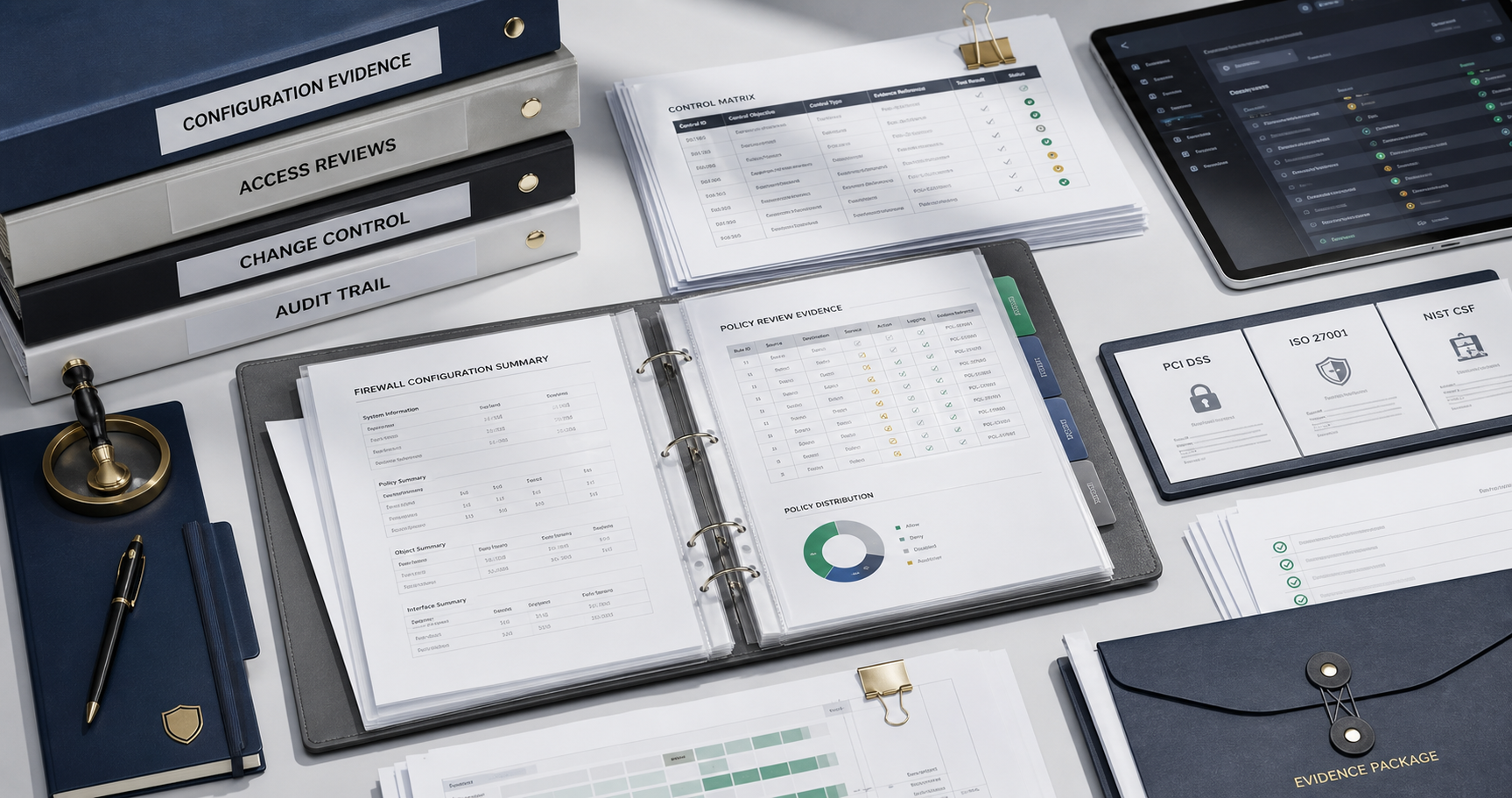
Compliance reviews become painful when the evidence is assembled at the last minute. Policies may describe what the organisation intends to do, but reviewers also need evidence of what the firewall is actually configured to do.
Firewall audit readiness means being able to connect a control requirement to a current configuration, a clear result, and an owned remediation or exception.
What useful firewall evidence looks like
- The firewall and configuration date are clearly identified.
- The relevant rule, object, interface, account, or security profile is shown.
- The finding explains why the setting matters.
- The evidence can be repeated using the same review method.
- Exceptions include an owner, reason, approval, and review date.
- Remediation can be tracked to completion.
Questions to answer before an assessor asks
- How are administrative paths restricted?
- How are broad or high-risk rules reviewed?
- How is segmentation checked?
- Which traffic is logged, and how is that verified?
- How are temporary rules and exceptions removed?
- How do you prove that remediation stayed in place?
Standards mapping helps, but it has limits
Mapping a finding to PCI DSS, ISO 27001, NIST, CIS, or another framework can explain the control intent. It does not by itself prove compliance. Scope, business context, compensating controls, and formal assessor judgement still matter.
ConfigSentry keeps the standards context attached to the underlying FortiGate evidence, making it easier to explain the issue without turning the report into a generic compliance checklist.
Run a ConfigSentry audit before the evidence request arrives, then use the results to fix gaps, document exceptions, and prepare a cleaner review pack.